

For decades, the world of electric guitars and basses has been tied to an almost sacred reverence for the usual traditional woods. Maple, mahogany, rosewood, and ash have been the undisputed pillarsupon which the entire history of rock and modern music has been built. In recent years, however, a quiet but incredibly fascinating revolution has been gaining ground within artisan workshops.
More and more luthiers and enthusiasts have begun experimenting with unconventional instrument-making, demonstrating that to build an instrument with a great sound and breathtaking aesthetics, one can look far beyond the conventions of the past, embracing creative reuse and eco-friendly innovation.
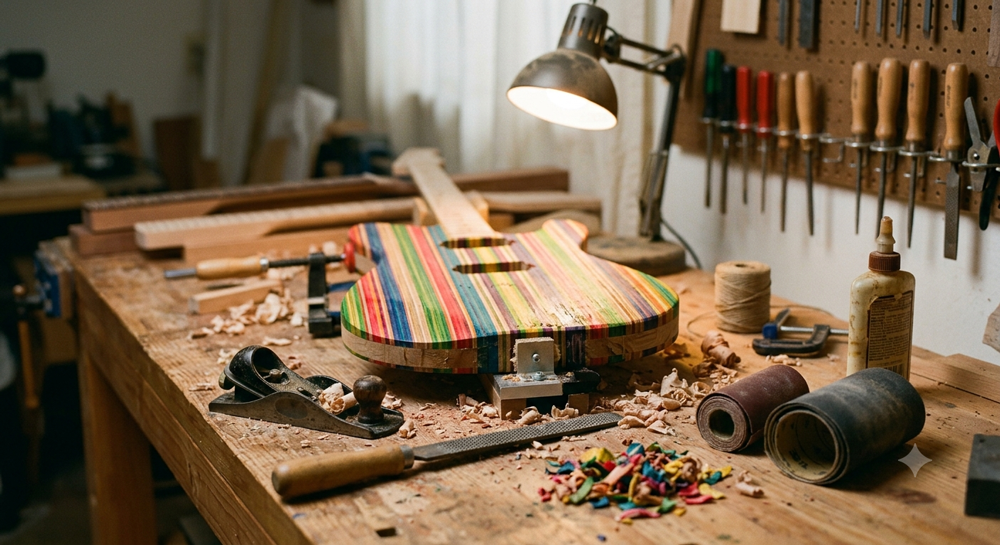
One of the most spectacular and sought-after trends on the web is undoubtedly the crafting of guitar and bass bodies starting from made from recycled skateboards. Old skateboards—destined for the landfill after being broken or worn out by street performers—actually turn out to be a top-quality raw material. Composed of multiple layers of maple wood pressed together at extremely high pressure using special adhesives, these boards offer truly remarkable density and structural rigidity. By gluing together dozens of shaped boards and cutting them to form the guitar body, the result is an instrument that is not only incredibly durable and responsive to touch but also features a completely unique and one-of-a-kind pattern of colored stripes.
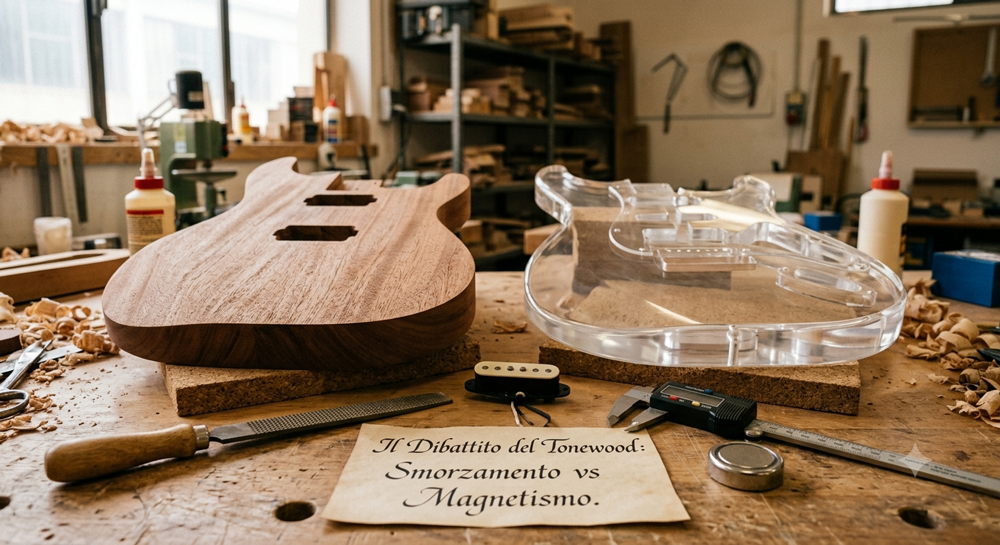
Alongsidethe street culture of skateboarding, another major player in modern instrument-making is the epoxy resin used in the famous “river table” style creations. The combination of blocks of raw wood or natural burl with pours of clear or pigmented epoxy allows for the creation of instruments that look like true works of contemporary art. From a construction standpoint, the resin offers unique advantages and challenges: it guarantees exceptional stability and a mirror-like finish with immediate visual impact, but requires great care during bench work and careful management of the instrument’s final weight. In terms of acoustic response, the combination of the solidified liquid mass and the wood’s grain delivers a decisive attack and a prolonged sustain that surprises even the most skeptical musicians.
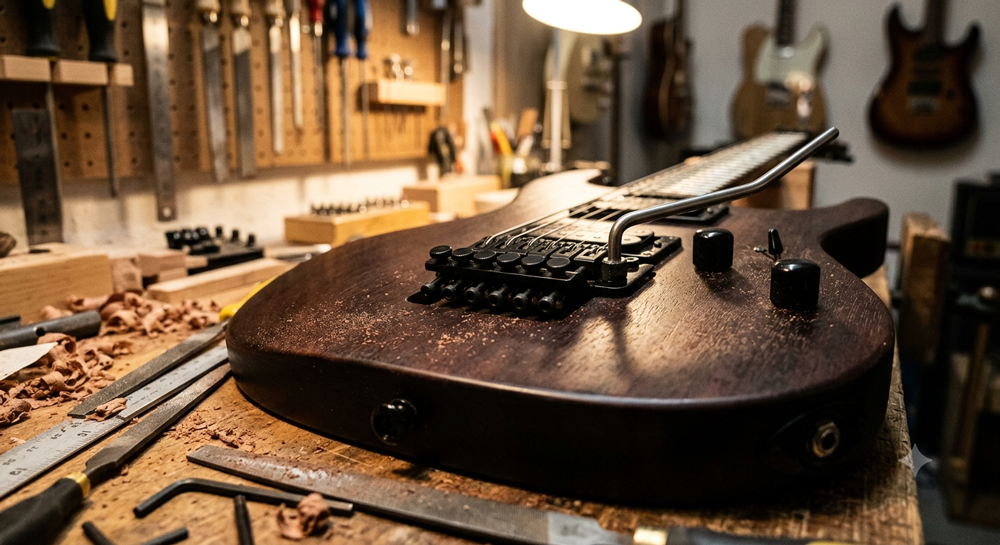
Pushing even further beyond the boundaries of time, some master artisans have begun to explorethe use of millennia-old and fossilized woods, such as the famous Bog Oak, also known as peat bog oak. These are logs that have lain buried for millennia in oxygen-deprived environments beneath mud and peat, where the minerals in the soil have gradually reacted with the wood’s tannins, giving it a dark, almost black hue and a density nearly like stone. Playing a bass or guitar made from this material means holding a piece of Earth’s natural history in your hands—one capable of delivering deep resonance and an incredibly defined low-to-mid-range frequency response.
Experimenting with alternative materials, recycled objects, and unusual woods is therefore not just a passing fad designed to impress on social media, but a genuine evolution of musical craftsmanship. The instrument-making of the future demonstrates every day that the true character of an electric instrument does not lie in the rigidity of past dogmas, but in the passion and vision of those who know how to transform the unexpected into pure music.