

Hello, fellow musicians, and welcome to the dusty, fascinating heart of the workbench. If there’s one piece of hardware that literally splits the world of electric guitars right down the middle, it’s undoubtedly the Floyd Rose. You either love it madly for its endless expressive possibilities, or you hate it with a passion every time you have to change the entire set of strings or do a drop tuning on the fly.
Born in the 1970s from Floyd D. Rose’s brilliant idea, this locking tremolo bridge system changed the history of rock and metal forever, allowing guitarists to thrash the vibrato arm without going out of tune. But how does it really work under the hood? What are its true strengths and the flaws that drive every beginner to despair? And above all, on which instruments and in which musical genres does it meet its natural end?
Anatomy and Function: How a Floyd Rose Bridge Works
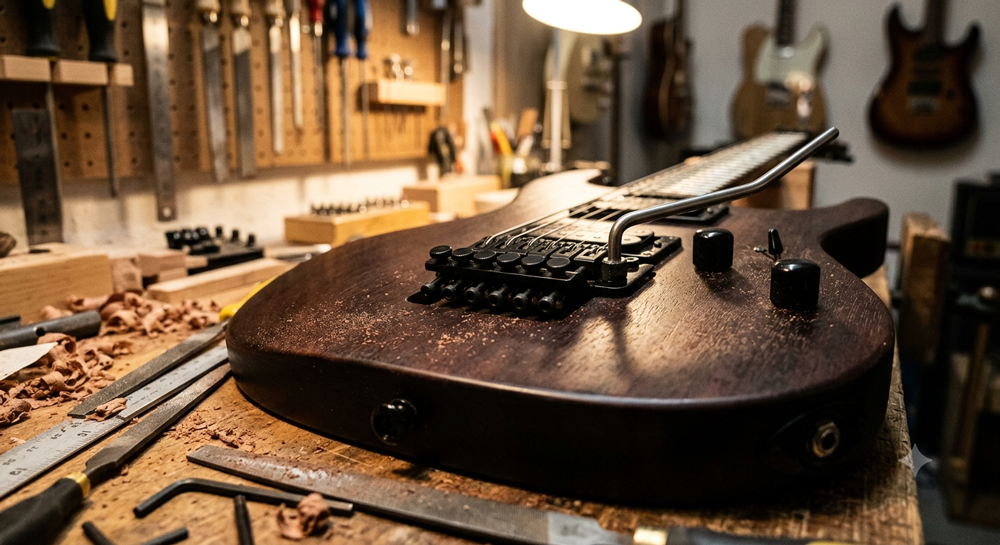
To understand the Floyd Rose, you have to think of it not as a simple bridge, but as a force-balancing system. Unlike classic fixed bridges or traditional Stratocaster-style tremolos, the Floyd Rose relies on a delicate physical balance based on two main pivots around which the metal plate swings.
On the opposite side of the strings, hidden inside a recess in the back of the guitar body, tension springs counteract the pull exerted by the strings themselves. The true secret heart of the system, however, is the dual locking mechanism. On one side is the locking nut mounted above the neck, which secures the strings with three Allen screws, preventing them from slipping during extreme lever movements. On the other side, the saddles on the bridge itself lock the string end after it has been cut, providing a rock-solid anchor point.
This means that, once the string retainers are closed, the basic tuning is complete, and the fine-tuning screws and fine tuners located directly on the bridge are used for minor adjustments.
The Advantages: Why It Has Captivated Entire Generations of Guitarists
The main reason the Floyd Rose has become legendary lies in its pinpoint tuning stability. Before its invention, performing an acrobatic dive-bomb (that “dive” effect where the lever is pushed until the strings go completely slack) inevitably meant finding the guitar completely out of tune. With the Floyd Rose, thanks to its total locking mechanism, the strings return exactly to their original tension point.
Another major advantage is its incredible expressive range. The lever can be used not only to lower the pitch, but thanks to the recessed routing in the body, it can be pulled upward (pull-up) to reach stratospheric highs, screeching artificial harmonics, and modulations that no other bridge can replicate with the same mechanical precision.
Flaws: The Other Side of the Coin and the Luthier’s Struggles
No mechanical marvel is without its drawbacks, and the Floyd Rose is notorious for giving anyone who has to work on it a cold sweat. The biggest drawback is the complexity and slowness of changing the strings. Replacing the strings requires cutting them, locking them in place, adjusting them with the tension screws, and continuously balancing the tension of the rear springs until the bridge is perfectly parallel to the guitar body again. If you decide to change the string gauge, be prepared to recalibrate everything from scratch.
Furthermore, the Floyd Rose is an inherently “rigid” system. If even a single string breaks during a live performance, the overall tension drops instantly, and all the other strings go drastically out of tune, making it impossible to continue playing the song without adjusting the instrument (unless you install specific locking devices such as the Tremol-No). Finally, the presence of metal parts under tension and numerous screws requires periodic maintenance to prevent premature wear of the blades on the pins.
From a luthier’s perspective, the Floyd Rose is almost exclusively used on solid-body electric guitars designed with a structure capable of accommodating the deep cutaways required for its operation. It is most commonly found mounted on bodies made of basswood, alder, or maple, often paired with fast glued-in or bolt-on necks, typical of the super-strat world. Electric basses with this system, on the other hand, are rare as hen’s teeth and represent extremely rare historical exceptions, due to the enormous tension of the bass strings, which would make balancing the system an unmanageable nightmare.
When it comes to musical genres, the Floyd Rose reigns supreme in hard rock, heavy metal, and ’80s shredding. Legendary bands and guitarists such as Eddie Van Halen, Steve Vai, Joe Satriani, and Dimebag Darrell have made this tremolo arm a true extension of their instrumental voice. However, it is also widely used in progressive metal and modern metal, where technical expressiveness and extreme phrasing require surgical precision and rock-solid stability.