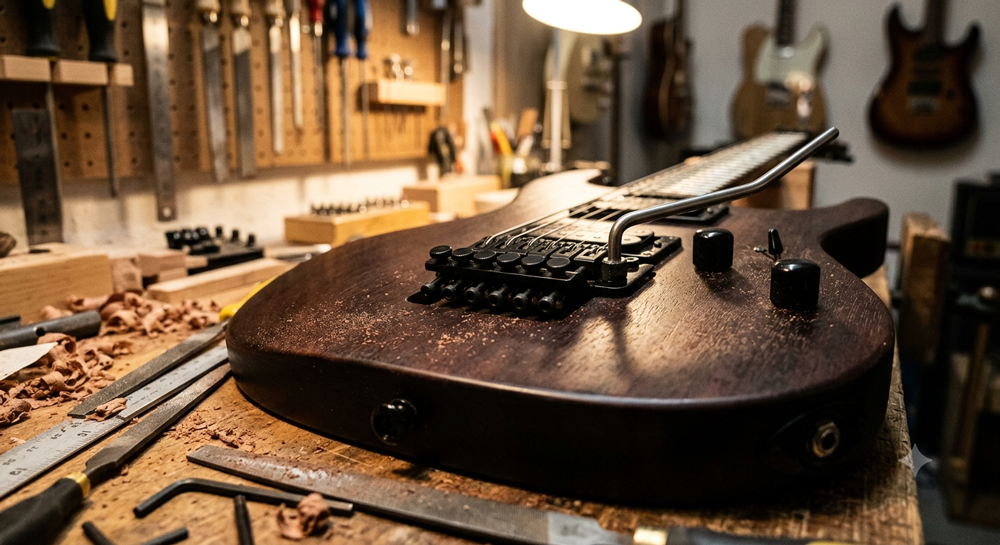


Hi, fellow musicians, and welcome back to the workshop. Today I want to touch on a very sensitive topic—one of those subjects that, when brought up on a guitar forum, spark religious wars worse than those between tube and digital amplifiers. Let’s talk about tonewood. Does it really exist on an electric guitar? Does the wood of the body affect the amplified sound, or are we just talking about pure collective suggestion? As a luthier, here’s my take: it’s one of the most complex and fascinating questions in our world, a cross between pure physics and musical magic.
Traditionalists will tell you that a mahogany body produces warm, deep mids, while ash or alder provide the brightness and “twang” characteristic of certain classic sounds. This theory has its roots in acoustic instrument making, where the wood serves as the soundbox and literally produces the sound. With electric guitars, however, the process is different: we have magnetic pickups that pick up the vibration of a metal string.
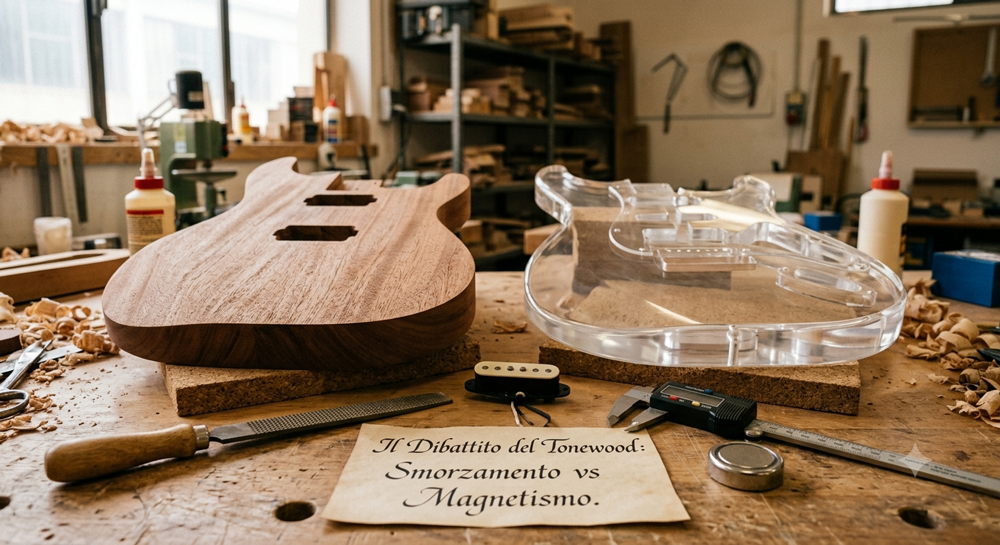
And this is where the skeptics come in. Magnetic physics tells us that the pickup only translates the movement of the string within its field. If the string vibrates the same way on a piece of fine mahogany or on a laminate kitchen countertop, the pickup should send the same signal to the amplifier. There are extreme experiments online showing guitars made of pressed cardboard, concrete, or even transparent bodies made of Plexiglas and aluminum that, incredibly, sound like… electric guitars. For many, ninety percent of the tone comes from the pickups, electronics, amplifier, and, above all, the guitarist’s fingers.
So, are we luthiers—who spend hours selecting pieces of flamed maple—just romantic dreamers? Not exactly. The truth, as is often the case, lies somewhere in the middle. It’s true that the wood doesn’t produce the sound that comes out of the amplifier’s speaker, but it has a huge impact on how the string vibrates. Every material has its own cellular density and stiffness—parameters that determine how it absorbs or reflects certain frequencies.
Let’s get into the technical details a bit without boring you. The body of an electric guitar acts as a passive mechanical filter. When we pluck a string, it transfers energy to the body through the bridge and the nut. The body begins to resonate, but in doing so, it “steals” energy from the string. Mahogany, for example, being a wood with a porous yet dense structure, tends to have a high damping coefficient at high frequencies. It absorbs the highest harmonics, allowing the midrange and low frequencies to dominate, which we perceive as a “warm” sound. In contrast, very rigid and compact woods such as hard maple have low damping: they reflect more energy back to the strings, maintaining a bright attack and prolonged sustain.
Plexiglass and aluminum—materials that are acoustically inert compared to wood—behave quite differently: they have very little internal resonance and almost no damping, which can result in an extremely sterile, almost “laboratory-like” sound—one that is very faithful to the electronics but lacks the organic compression that wood naturally provides.
The tonewood on an electric guitar is therefore not a sound generator, but a mechanical calibration tool that shapes the attack, dynamics, and sustain of the note even before the pickups pick it up. And let’s not forget the “feel” factor: playing an instrument that vibrates nicely against your chest and smells and looks fantastic makes you play better. Whether you choose traditional mahogany or a futuristic body made of synthetic material, the important thing is that the sound moves you. The magic of music is also made up of these invisible nuances.